Left Atrial Appendage (LAA) Closure in Ahmedabad for Stroke Prevention in AFib
What is LAA closure?
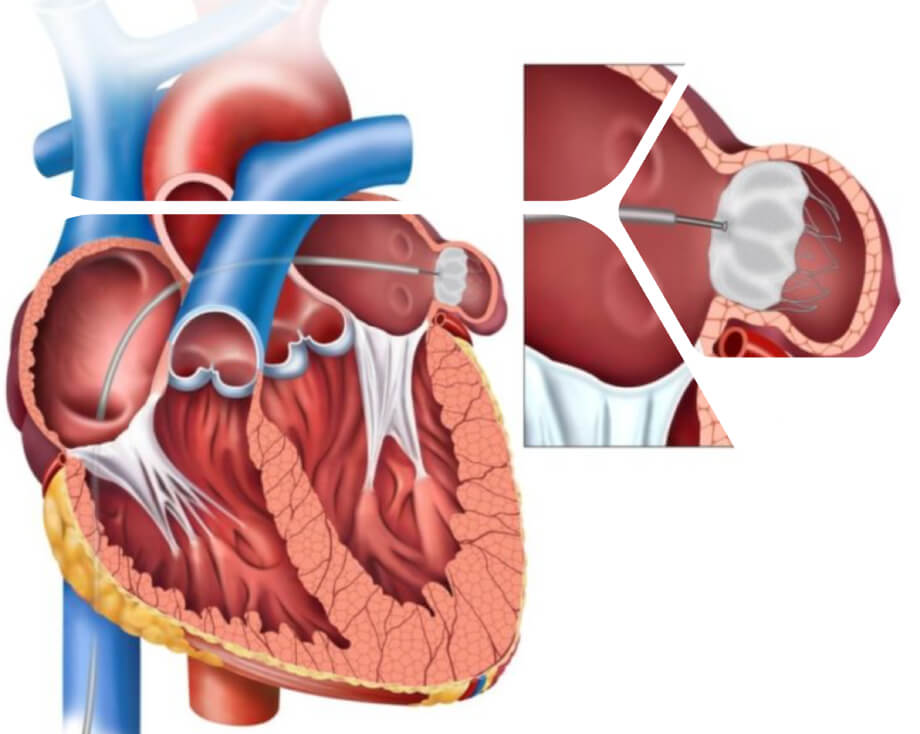
In atrial fibrillation the upper chambers of the heart quiver, and blood can pool and clot in the left atrial appendage (LAA), a small pouch of the left atrium. A clot can travel to the brain and cause a stroke. Most clots in non-valvular AFib form in the LAA. LAA closure seals this pouch with a device so that clots cannot leave it.
Why is it done?
- The procedure is done in the cath lab, usually under general anaesthesia, and guided by TEE or other imaging.
- A catheter is passed through the vein in the groin to the right atrium. A small puncture is made across the wall between the upper chambers to reach the left atrium.
- The device is released at the opening of the LAA. Imaging checks its position and the seal.
- Tissue gradually grows over the device. Medicines to prevent clots are continued for a period after the procedure, as advised, and follow-up imaging (TEE or CT) is done after some weeks to check the seal.
What is the purpose of LAA closure?
The aim is to lower the risk of stroke in patients who cannot stay on long-term blood thinners. In studies, LAA closure was compared with warfarin and was found to be similar for stroke prevention overall. Most data are from selected patients, and the benefit differs from patient to patient. The decision is made after weighing the stroke risk against the bleeding risk.
Who may be considered?
- Patients with non-valvular AFib (AFib not caused by a significant mitral stenosis or a mechanical valve)
- Patients with a high stroke risk
- Patients with a reason to avoid long-term blood thinners, such as earlier major bleeding or a high bleeding risk
Imaging checks the shape and size of the LAA and whether a clot is already present.
Risks and considerations
- Fluid around the heart (pericardial effusion), which may need drainage
- Device moving from its position or a leak around the device
- A clot forming on the device
- Stroke, bleeding and injury at the groin
- Allergy to the contrast dye or to device material
Related mitral procedures on this website
Frequently Asked Questions
Does LAA closure cure atrial fibrillation?
Can I stop blood thinners after LAA closure?
Is LAA closure open-heart surgery?
Is everyone with AFib a candidate?
Disclaimer: The medical information provided on this website is for educational and informational purposes only and should not be considered as medical advice, diagnosis, or treatment. Always consult a qualified healthcare professional regarding any medical condition or treatment decisions. While every effort is made to ensure accuracy, doctor and/or clinic and/or hospital does not guarantee the completeness, reliability, or accuracy of the information published. Treatment outcomes may vary from patient to patient. This website does not offer diagnosis or treatment online. In an emergency, such as severe chest pain, fainting, sudden weakness or severe breathlessness, go to the nearest emergency department.

Dr. Abhishek Rajpopat is an interventional and structural heart cardiologist in Ahmedabad, Gujarat.
Specialities
Get In Touch
Epic Hospital, Rajpath Rangoli Rd, behind Rajpath Club, off Sarkhej – Gandhinagar Highway, Bodakdev, Ahmedabad, Gujarat 380054