TAVR
TAVR
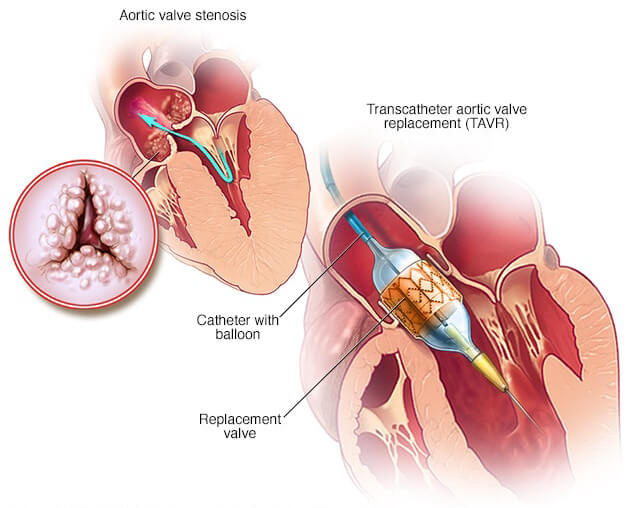
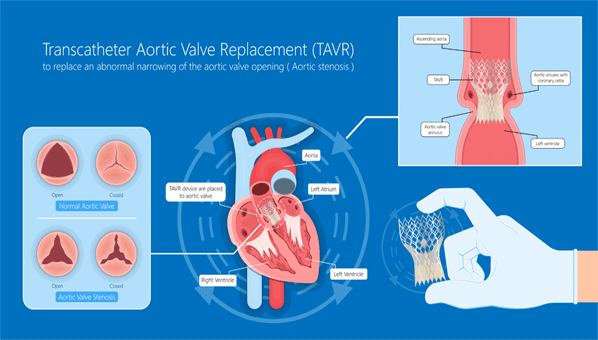
- Transcatheter aortic valve replacement (TAVR) is a minimally invasive procedure used for the treatment of aortic stenosis.
- It is suitable for aortic stenosis patients who can not undergo open-heart surgery due to comorbidities.
- TAVR does not require a long incision, instead a thin tube is inserted into the patient’s artery through a tiny incision in the arm or groin area.
- TAVR is of two types : Self-Expanding Valves and Balloon-Expandable Valves.
LONGEVITY OF TAVR
- In a 2019 study, 91% of patients who underwent the TAVR procedure didn’t show any signs of severe valve degeneration 5 to 10 years post-implantation.
- TAVR valves provides durability as good as or better than surgical bioprosthetic valves
How is TAVR done?
- The cardiologist makes a tiny incision in the groin and inserts a catheter with a balloon tip into an artery.
- The cardiologist uses moving X-ray images to properly position the catheter and guide it to the heart.
- Once the catheter reaches the aortic valve, a replacement valve passes through the catheter.
- The catheter’s balloon tip is inflated to insert the replacement valve into the correct position.
- The cardiologist removes the catheter after the replacement valve is secured in place.
Complication of TAVR
- Valve embolization or paravalvular leak
- The most serious complication of TAVR is the failure of the replacement valve or its leaking.
- Other risks are: Heart attack; Stroke or transient ischaemic attack (TIA); Blood clots; Bleeding and infection.
- Specific care is taken to avoid these complication post-procedure.
Who are eligible to undergo TAVR?
- Patients with a high risk of open-heart surgery.
- Patient who cannot undergo invasive procedures due to previous ailment such as liver/lung diseases.
- Patient who are undergoing the process again due to the previous valve narrowing.
Who is not eligible to undergo TAVR?
- Patients who have had previous mechanical valve surgery at the aortic valve location.
Diagnostic Tests required to undergo TAVR procedure
- Electrocardiogram
- Echocardiogram
- Transesophageal echocardiogram
- CT aortogram
How is Dr. Abhishek Rajpopat the best doctor to receive your TAVR?
- First person in western India who has used valve
- Earliest doctors to perform TAVR procedure
- Personalized pre-planning for TAVR procedure
- Uses modern equipments for valve replacement
- Minimal pain procedure
Disclaimer: The medical information provided on this website is for educational and informational purposes only and should not be considered as medical advice, diagnosis, or treatment. Always consult a qualified healthcare professional regarding any medical condition or treatment decisions. While every effort is made to ensure accuracy, doctor and/or clinic and/or hospital does not guarantee the completeness, reliability, or accuracy of the information published. Treatment outcomes may vary from patient to patient.

Dr. Rajpopat is a highly respected cardiologist based in Ahmedabad, known for his exceptional skills in treating complex heart conditions.
Specialities
Get In Touch
Epic Hospital, Rajpath Rangoli Rd, behind Rajpath Club, off Sarkhej – Gandhinagar Highway, Bodakdev, Ahmedabad, Gujarat 380054