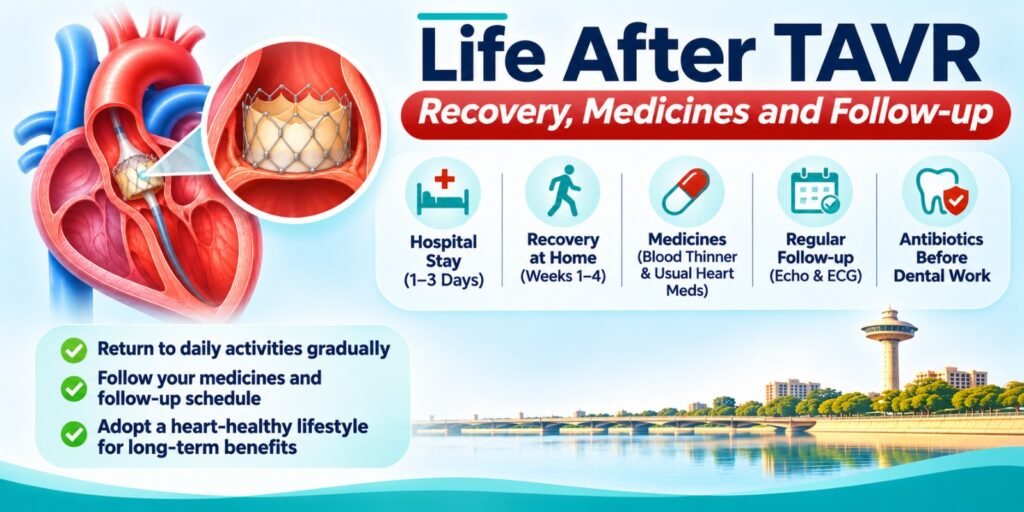
What happens in the hospital after TAVR?
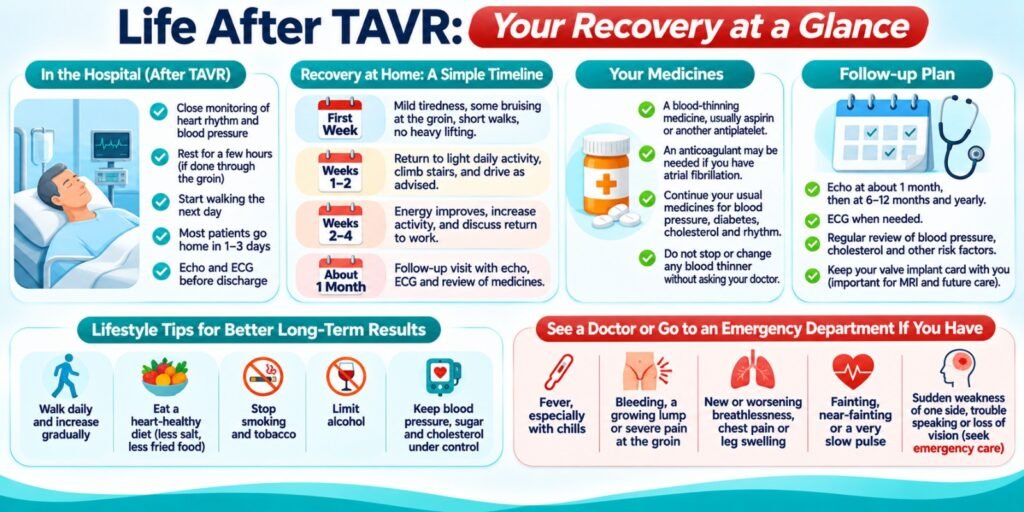
- You are watched in a recovery area or intensive care unit for some hours, with heart rhythm and blood pressure monitoring.
- You lie flat for some hours if the procedure was through the groin, so that the puncture can seal.
- Walking starts the next day, and most patients go home in one to three days. Some stay longer, depending on the heart rhythm, the access route and other illnesses.
- An echo is done before discharge to check the new valve, and an ECG to check the heart rhythm.
A few patients develop a slow heartbeat after TAVR and need a pacemaker. This is why the rhythm is watched closely in the first days.
What is the recovery like at home?
Time | What to expect |
|---|---|
First week | Mild tiredness. Bruising or a small lump at the groin is common. Short walks several times a day. No heavy lifting. |
Weeks 1 to 2 | Most people return to light daily activity and can climb stairs and walk longer. Driving and travel as your doctor advises. |
Weeks 2 to 4 | Energy improves steadily. Heavier activity and return to work, depending on your job, are discussed at the first review. |
About 1 month | Follow-up visit with echo, ECG and review of medicines. |
This is a general guide. Recovery depends on your age, your fitness before the procedure, and the access route used.
How do I look after the wound?
- Keep the groin site clean and dry. Ask when you can shower and when to remove the dressing.
- Some bruising is normal. A growing swelling, bleeding, severe pain, redness or fever is not. Report it the same day.
- Avoid heavy lifting and straining for the period your doctor tells you.
Which medicines will I need?
- A blood-thinning medicine, usually aspirin or another antiplatelet. If you have atrial fibrillation, an anticoagulant may be used instead or as well. The choice and duration are decided for each patient.
- Your usual medicines for blood pressure, diabetes, cholesterol and heart rhythm continue unless your doctor changes them.
- Do not stop or change a blood thinner without asking your doctor, even if you feel well.
Do I need antibiotics before dental work?
Yes. A heart valve implant, including a TAVR valve, can be infected by bacteria from the mouth. Tell your dentist and doctor about your valve and take the antibiotic they advise before dental procedures. Brush twice a day and have regular dental check-ups.
What follow-up is needed?
- An echo at about one month, then at 6 to 12 months and then yearly, or as advised.
- ECG when needed, to look for rhythm problems.
- Regular review of blood pressure, cholesterol and other risk factors.
- Carry your valve implant card. Most TAVR valves are MRI-conditional, and the card tells the MRI team what is safe.
A TAVR valve is a tissue valve. Follow-up so far is encouraging in selected patients, but long-term data are still being gathered, which is part of the reason for yearly echo.
What lifestyle changes help?
- Walk daily, and increase the distance slowly. A cardiac rehabilitation programme helps many patients.
- Eat a heart-healthy diet with less salt, less fried food and more vegetables, fruit and pulses.
- Stop smoking and tobacco, and limit alcohol.
- Keep blood pressure, sugar and cholesterol under control.
When should you call your doctor, or go to an emergency department?
- Fever, particularly with chills, after the procedure or after dental work
- Bleeding, a growing lump, or severe pain at the groin
- Fainting, near-fainting, or a very slow pulse
- New or worsening breathlessness, chest pain or swelling of the feet
- Sudden weakness of one side of the body, trouble speaking or loss of vision: go to an emergency department at once
Frequently Asked Questions
How long does it take to recover after TAVR?
Most patients go home within one to three days, and return to light daily activity in one to two weeks. Full energy usually returns over a few weeks. It depends on your age and health before the procedure.
When can I drive after TAVR?
Many patients can drive after about a week if there are no rhythm problems and the groin has healed. Your doctor will tell you the right time for you.
Can I climb stairs and walk normally after TAVR?
Yes, in most cases, and many patients find they can do more than before. Start with short walks and increase gradually.
Do I need to take blood thinners for life after TAVR?
Many patients take a single antiplatelet such as aspirin for the long term, and some need an anticoagulant, particularly if they have atrial fibrillation. Your doctor will decide what you need.
Can I have an MRI after TAVR?
Most TAVR valves are MRI-conditional under certain settings. Show your implant card to the MRI team.
How long does a TAVR valve last?
Long-term results are still being gathered. Follow-up so far is encouraging in suitable patients, but the valve is a tissue valve and will not last forever. Regular echo is part of the plan.
Will I need a pacemaker after TAVR?
A small number of patients do, usually within the first days, because the valve sits close to the heart’s wiring. Your rhythm is monitored before you go home.
Is TAVR follow-up available in Ahmedabad?
Yes. Dr. Abhishek Rajpopat follows patients after TAVR in Ahmedabad with echo and clinical review.
About Dr. Abhishek Rajpopat
Dr. Abhishek Rajpopat is an interventional and structural heart cardiologist in Ahmedabad. MD, DM (Cardiology), FSCAI. Fellowship in Structural Heart Diseases (Denmark). For appointments and queries, please use the Contact page.